
A standing order, written as a sheet: what is supplied, in what pack, on what cycle, and what is checked when it lands
CLEAN SWEEP SUPPLY LTD holds cleaning consumables and janitorial equipment for offices, lettings agents and small contractors, and carries out a scheduled general clean of the buildings it supplies. Both sides read off one sheet.
A line names the thing, the pack says how it arrives, the cycle says how often, and the last column says what is counted at the door. Orders are taken by email at orders@cleansweepsupply.store.
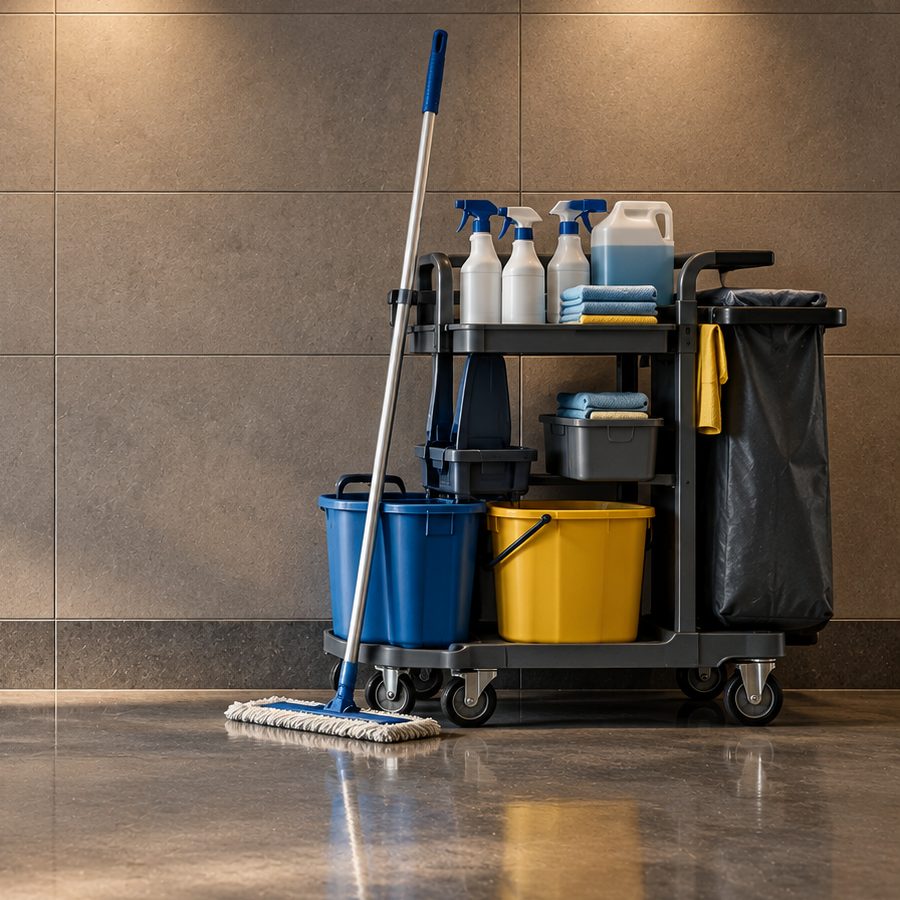
Editorial photograph. Not this company’s premises or stock.
A cycle is a bay emptying
A standing order is easiest to picture as a run of shelf bays. Each bay is one pack, and the cycle is the rate at which the fill steps down the run. The last bay is outlined rather than filled: it is held against the lead time, so it is ordered against rather than counted on.
The run stands drawn: six bays carry fill, the seventh is held.
- Line
- One thing supplied, named once and not renamed.
- Pack
- The form it arrives in: an inner, an outer, a case or a drum.
- Cycle
- How often the line is brought back up: weekly, fortnightly, four-weekly, on call.
- Cover
- How many weeks the shelf lasts at the rate it is used. Worked out, never assumed.
How a line is written
A line is written once and then left alone. It carries the material, the form and the size, and nothing else. A line that describes a product name stops being orderable the moment the name changes.
Underneath the wording sits the pack, which matters more than it looks. A line ordered in inners and counted in outers is short every time without anybody being wrong, so the sheet states both figures.
Then the cycle, chosen against use rather than habit. The shelf is brought back up before it empties, and the week it would have emptied can be worked out from three figures. A line used unevenly is held on call instead.
The last column is the check: the pack count, the seal, the size printed on the pack, and whether what came matches what was ordered. It sits beside the line, so the person at the door reads one row.
The sheet, read across
Five columns. The rules between them hold their place as the page narrows — they thin, but they never drop out, because a column with no rule beside it stops being a column.
Five columns is wider than a narrow screen. The sheet keeps all five and every rule between them, and slides sideways inside its frame rather than dropping any of them.
| Group | Line | Pack | Cycle | Checked at the door |
|---|---|---|---|---|
| Washroom | Folded hand towel, interleaved | Sleeve in an outer | Fortnightly | Sleeve count; width against the dispenser |
| Washroom | Liquid hand soap, refill | Cartridge in a case | Four-weekly | Case count; seal intact; fits the unit held |
| Floors | Neutral floor detergent, concentrate | Drum | On call | Drum count; cap seal; dilution on the label |
| Floors | Flat mop head, microfibre | Inner of ten in an outer | Four-weekly | Inner count; width against the frame issued |
| Surfaces | Folded cloth, colour-coded | Pack of fifty | Weekly | Pack count; colours present in the agreed set |
| Waste | Waste sack, flat, two gauges | Roll in a case | Weekly | Roll count; flat size against the bin; gauge marked |
| Issued | Trolley, mop frame, buckets | Single unit, on an issue note | Issued, not cycled | Unit number read back; condition on the note |
The last row behaves differently from the six above it and is written here anyway: equipment is issued against a note and comes back, and keeping it on the same sheet stops a trolley being treated as something used up. The equipment page carries the issue-and-return side, the consumable lines page the pack arithmetic.
What loads, and in what order
- Rows pickedRead off in group order: washroom, floors, surfaces, waste.
- Packs brokenAn outer is opened only where the round needs part of it; the remainder goes back marked.
- Equipment hungFrame, buckets and cloth set against that building’s issue note, by unit number.
- Sheet closedCounts written against their own lines; on-call lines counted at the door.
The rule this sheet is written to
A standing order is a promise about a shelf, not about a warehouse. The figure that matters is the week the last pack opens, and that figure belongs to the building.
That rule is why both tools below print their arithmetic rather than a verdict. The figures are the reader’s own, and the sheet knows nothing about any real shelf.
Consumable run-rate sheet
Four figures in, every step of the arithmetic out. Guide only: this is arithmetic on numbers you type, not a stock system.
A worked example stands in the sheet; typing into any field reworks all four lines.
Four checks close a delivery
-
Count against the line
Packs are counted whole and read back against the line as written, in the pack the line names. A count taken in another pack is not a count.
-
Size against what it feeds
A towel sleeve is measured against its dispenser, a sack against the bin, a mop head against the frame issued. The pack states the size; the shelf does not.
-
Seal and condition
Drums and cartridges are checked for an intact seal before signing. Anything damaged stays on the trolley, and what goes back is written on the same row.
-
Numbers read back
Issued equipment is read back by unit number against its note, condition written beside the number. The note closes when the unit returns.
The whole sequence is set out on the picking and handover page.

The scheduled clean, and the hours a cycle takes
The general clean runs on the supply side’s logic: a cycle covers a stated set of rooms, a visit is a stated number of hours. The scheduled clean page sets out what a visit covers and what closes it.
Guide only, and the same arithmetic a supervisor does on paper. A room longer than a whole visit is reported, not averaged away.